2007/05/18

Kudos to Sean Gordon

It is not often we get a straight piece of reporting on the issue of congestion pricing. Sean Gordon, Quebec Bureau Chief for the Toronto Star wrote just such a piece: Montreal eyes downtown tolls on 18 May, 2007.

It is refreshing to know that a journalist can still report on something and leave his opinion out of it, to let the reader decide for themselves. Nowhere in this article can I tell if Gordon is for or against tolling. I can’t tell if he drives an SUV or uses a bike. That is as it should be.

The only bone I could pick, since that is my job (and I am 100% biased toward proper congestion pricing) is the characterization of Mayor Tremblay’s plan as “presumably patterned on London, England's successful anti-congestion strategy”. If Mr. Gordon means: toll the busy inner commercial core to encourage alternate modalities, then I would concede accuracy. But if he means: set up cameras at ~300 intersections at a cost of $600M (the cost of the first two stages of the London Congestion Charge (LCC) system) and charge a fixed entrance fee, I hope very much he is wrong.

Why? Because a simple one-size-fits-all cordon-fee distinguishes only among drivers who will take their car into the CBD and those who will not. (Yes, I get that is important.) But such a charge is a blunt, regressive instrument. And this is well known criticism of the LCC – indeed our own Toronto Councillor Brian Ashton has traveled to London to review the LCC, and he has rejected this system, presumably for this reason as well as the mistaken notion that we must have a subway system the relative size of London’s, first.

Since the endgame for congestion pricing is to replace the fuel-tax-based economy with a pay-as-you-use-it economy, we need to mete out road access by distance. And location. And degree of congestion. In other words, pay for your externalities, not your gas.

As we start the engines of the road-pricing debate, we will too often refer to the LCC as the model. It is the model for bold action, and Mayor Livingstone deserves all of the praise he garners. But it is not the model for economic efficiency, system efficiency, urban aesthetics, or fairness.

While Mayor Livingstone has been a guiding light for other more timid mayors, his specific system architecture should never be copied.

2007/05/16

Are We Slapping or Servicing Motorists?

In Wednesday’s Star, 16 May 2007, Jim Byers wrote a piece called N.Y. mayor wants tax on drivers. While this purports to be a simple piece of reporting, his language colors his work with his personal grudge against congestion pricing and biases the reader.

When you report on congestion pricing by calling it a “tax”, you automatically have the reader hear “punitive” rather than “pay-for-use”. In Toronto, this is especially a problem because the new taxing powers that Mayor Miller has are just that – taxing powers. Conversations about sin taxes and road-user-fees are lumped together in past reporting to make it all look like a huge fiscal correction to our City’s financial woes. The value of congestion pricing to us motorists and to the environment is lost in the fiscal emergency and in the biased reporting language.

Here is At Mayors’ Summit, Bloomberg Campaigns for Clean Air published on the same day by the NYT. This reporter used “fee” and not “tax” – and its her city!

Here is a piece from the New Yorker that also discusses the matter with less bias. The words “fees”, “tolls”, and “pricing” figure prominently (which is what they are). “Tax” only shows up in the sentence “taxis would be exempt”.

But Mr Byers can be forgiven his use of the word “tax” – he’s hardly the first. In fact, Byers is in good semantic company. The economist Greg Mankiw discusses this…

“there is some debate about whether road pricing is really a Pigovian tax or just a user fee for consuming a scarce resource. …. When people are not charged (or are undercharged) for using a common resource such as a congested road, then incremental use of the resource entails a negative externality on other users. Imposing a user fee for the scarce resource can be described as a Pigovian tax to deal with this externality. Similarly, a conventional Pigovian tax such as a tax on pollution emissions can be described as a user fee for consuming clean air. The distinction between user fee and Pigovian tax in these cases is purely semantic.”

But Byer’s one-word version of Professor Mankiw’s long-winded but carefully drawn distinction abuses his readers.

Unfortunately, he compounds his error, when he writes: “[Bloomberg] has proposed slapping an $8 (U.S.) fee on drivers who come into Manhattan…”.

“Slapping” carries clearly punitive connotations, bringing to mind more of a traffic fine than a per-use fee. If Bloomberg uses those fees to fund transit and to open roads or to do something green, he's providing more service to motorists than he is slapping them for driving. Why else did Stockholmers vote their road-use charge back in? Not because they felt slapped.

The truth of the matter is that journalists and reporters often use language in ways that harm the environment by negating the value that bold politicians such as Bloomberg or Livingstone bring to the table.

Journalists’ greatest value to society is to uncover the truth. Defending one’s god-given entitlement to free access to roads brings no value.

2007/05/15

Two years in prison

The average motorist commutes each workday about 76 minutes in the GTA. About 30 of these minutes, are lost to congestion. Assuming a five day work week, after 32 years, a motorist will have spent two years standing in traffic. Since we have as yet no workable plans to solve this problem, this is like a two-year jail sentence with no chance of parole.

If road pricing were used to help solve this problem, we might expect to pay about five cents per kilometer to use these roads. If you commuted each day from Oakville to Toronto, that would be a round-trip of 76 km. Those 32 years of commuting at five cents a kilometer would cost you $30,400 in 2007 dollars, if you continued to use your car. If you were to go to prison instead that would imply that you value your life at $15,200 per year. That's about minimum wage.

But few people working at minimum wage can afford a car.

Since they are mostly without cars, the mathematics of congestion pricing does not harm poor people. But the mathematics of NOT deploying congestion pricing harms all of us, and the jail time is only part of it.

And that is the good news.

The bad news is that congestion is still on track to get about 3 times worse between now and 2030.

Your jail time is about to be compounded, and there is still no chance of parole. You should demand your councilor fight for congestion pricing on your behalf as a human right.

2007/05/13

Capitalism, Communism, Cars and Congestion

Not long ago I mused over the analogy between communism and our use of congestion as the manager of social equalization. In May 7, 2007 edition of Time Magazine, in their weekly list of ironic or amusing outtakes, the following appeared:

'Using economics to influence behavior is something this country is built on—it's called capitalism.' MICHAEL BLOOMBERG, New York City mayor, who is considering charging people a fee for driving into the heart of Manhattan

Fundamentally, Bloomberg is saying the same thing as was Joseph Giglio.

On the same page in Time, is their equally ironic and amusing “Numbers” column, where the following two statistics appeared:

2.35 million
Number of vehicles sold worldwide by Japanese car company Toyota in the first quarter of 2007

2.26 million
Vehicles General Motors sold in the same period, the first time Toyota has passed General Motors in quarterly sales to become the world's biggest carmaker

The socio-economic engine that creates the automobile will not moderate itself anytime soon. In fact, I myself look forward to buying another car before much longer.

Proper market pricing is the only solution. You, me, and every politician knows that. Unfortunately, too few admit it and even fewer have the courage to do anything about it.

I wish you success, Mayor Bloomberg.

2007/05/03

Toronto proposes to waste $1M

I was thrilled to read in Wednesday’s Globe that Toronto is proposing to address parking pricing in the City. Maurice Anderson gets top Shoupista marks for thinking “the hike will help ensure that drivers can find on-street spaces when they need them for short-term errands such as shopping”. That is what short term parking is for – convenience and commerce – get in, do your thing, get out.

But things went south from there.

Mr. Anderson gets very low marks for saying, "I think 50 cents is reasonable" and even lower for saying, “the new rates … compare to inflation over that time…”. Councilor Ashton dutifully and lazily repeated the inflation mantra to 680News, when he said “drivers should realize this would be the first increase at the meter in eight years …[a] 50 cent per hour increase is fair and is still a good deal for drivers compared to private lots.”

Then Councilor Ashton went on to say: “I think people look to the Toronto Parking Authority to get the best bargain for parking in Toronto, it's a great bargain”, which is true, but saying “I feel I want to go and park a couple more times to celebrate the good deal”, really ridicules the real issue.

Parking pricing is properly about access and congestion reduction, not about inflation adjustments and certainly not about celebratory parking. And yes, parking is useful to raise revenue and the City could and should raise much more this way.

Parking prices, when structured as poorly as they are in Toronto need to be reset to reduce “circling” or “cruising”. That is the technique many motorists use to go round and round the block at King and Simcoe (and every other busy street) so they can park for $4-6 for 2 hours instead of driving up four floors two blocks away to pay $16 for 2 hours.

Which would you rather do for a 90 minute shopping expedition, pay $5 and walk 30 steps in the daylight or pay $12 and walk two blocks through an underground parking lot? And isn’t it worth cruising slowly around the block three times to land one of those sweet spots? 15 cents in gas and 6 minutes of cruising to save $7 and a 6 minute stair-climb? It is absolutely worth it. Always.

Donald Shoup says drivers cruising for curb or metered parking generate 30 percent of traffic in business districts. He recommends that cities adjust the price of metered parking to keep 15% of spaces vacant and eliminate cruising. He says with balance between demand for parking and supply of spaces, cities would generate more revenue, which they could use to improve local public services.

Fellow Torontonians: cruising for parking causes congestion and emissions. Keep your incandescent bulbs and demand rational parking pricing instead. Fixing on-street parking in Toronto is easily the biggest free-lunch Mayor Miller can have with respect to green house gases. He’d be Canada’s greenest Mayor ever.

Mr. Ashton is not kidding when he says 50 cents is a bargain. But it is also an enormous rip-off of the livability and accessibility in our greatly congested City. Nothing to celebrate there, Councilor.

Pricing needs to be set to consider the convenience and cost payoff. You cannot underprice the convenient on-street spaces and expect people to use off-street parking.

So you ask: what should the increase be?

It should NOT be a simple increase, it should be a full rationalization. There are places all over the city that are correctly priced already. I park in a little GreenP near Woodbine for $4 (all day!) and take the TTC for $5. Total $9 and about the same travel time (I go pre-rush hour). I take my car in twice a week and park for $15 at an IMPARK. So I save $7 (gas is $1) when I park and ride. If the proposed parking increase hits that little lot, I expect the differential to be more like $5. You know for those $5, I’ll give the money to IMPARK. Why? My car. My music. My cell phone. I can talk to myself. I can watch women walking by.

You see IMPARK knows that, that’s how they can demand that price. Maybe the CFO of IMPARK should be our next mayor.

There are two ways to raise parking prices in Toronto.

The wrong way is a flat, regressive, lazy-minded, revenue-grabbing, across-the-board 50 cents. (Yes, there are the “Lake Shore” exceptions to the proposal, but that’s insufficient.)

The right way is to [1] lower and advertise prices in places where there’s under-demand (you would not know that my favorite lot is 50 cents per hour unless you actually drove in to see), [2] leave prices alone where there is about 85% peak-average demand and [3] and raise them in places where peak-average demand is in excess of 85%.

And there are a lot of streets in Toronto where peak-average demand exceeds 85%. A lot. And 50 cents doesn’t cut it. Some of those streets need $5 per hour – maybe more, but not $3.50. Toronto has departments full of traffic engineers and some of those understand Transport Demand Management very well. Why do we pay to keep this staff, but not consult them? There could not be a single TDM person in the GTA would promote this 50 cents across-the-board wasted opportunity. For the same $1M (or maybe $1.5M) you could rationalize on-street parking, reduce emissions, and raise at least twice the additional revenue for the City.

Politicians: When someone is too lazy, in too much of a hurry, or wearing high-heels (which covers at least 93% of the motorist population), they little care whether it is $3.50 or $5.00 per hour. They will pay for the convenience, safety and time-saving.

In his Globe article, Jeff Gray went on to report that Mr. Anderson said “another hike is unlikely for at least the next five years.” Since this proposal is so wrong, the real problem of parking pricing will require revisiting the following year – as will the City’s financial woes, of course. Since Mr. Anderson is leaving his post, the new executive can break Mr. Anderson’s promise for him. I certainly hope he does so soon.

We really need Toronto politicians to smarten up and structure user-fees to manage access and resources, to curb emissions and congestion. Not to raise revenues.

AND, I guarantee if you priced properly you will accomplish much more, including far more revenue. Toronto parking revenue can be tripled, and access to parking can be improved while reducing congestion to a modest degree – all at the same time.

~~~~~

If you are interested in understanding why parking rates that are not market balanced are detrimental to your city (causing congestion, emissions, lost time for motorists, and lost business to store owners), you need to read more of what Donald Shoup has to say about it. You can borrow his book from the Toronto library. No Urbanist should overlook this book.

2007/05/01

Environmental Defense


The Environment Defense site has a nice summary of Congestion Pricing. In fact, this whole page is informative and a delight to read. Best to enjoy that first, then come back…

This site describes four systems (London, Singapore, Stockholm, Norway) rather than the usual three (less Norway). I will use this to illustrate a gradient for congestion pricing.

First: a distinction between congestion pricing and road pricing is critical.

Congestion Pricing is charging for the use of a road in order to influence demand – hence Congestion Pricing is a “Transportation Demand Management” (TDM) tool. Ideally Congestion Pricing means you reduce peak hour demand by setting a price that encourages things like alternate travel modes, alternate times, carpooling, doubling of trip purposes, telework, even moving closer to a job. All of the money you pay to drive into London each day is congestion pricing.

Road Pricing is charging for the use of a road in order to recoup the money invested to build that road. The money you pay to use the Pennsylvania Turnpike is road pricing. Almost all of the money you pay to use Ontario’s 407 is road pricing.

Huh? 407? Congestion Pricing? Well, yes, but not really. The 407 has a base price for three classes of vehicles. For private passenger cars that price is currently $0.168 Canadian per km throughout the 24-hour day. For the morning and afternoon peak that is raised to $0.176 or a premium of 8/10th of a cent per kilometer – a mere 4.8% premium. Technically, this tiny increment is a congestion price since it is levied during peak hours, but would be clearly ineffective as a TDM tool. For the typical rush-hour trip this would amount to an unnoticed few cents for each motorist, but a nice total incremental revenue to the toll operator. If you wanted to apply congestion pricing to this roadway one might consider $0.10 per kilometer raised to $0.25 during peak hours. Unfortunately, since that road is has a free parallel road (Highway #7) such a “proper” congestion price would drive traffic away defeating the congestion relief that the 407 provides. So this is a case of a revenue-grab pretending to be a congestion price.

So the fact is that while these two terms often get blurred in the press and in your pocket, the reasoning, design and purpose behind them is quite different. One produces revenue and may inadvertently signal that it is expensive to drive a car; the other signals that it is terribly expensive to drive in congested places and at busy times and also intentionally produces revenue that is ideally used to improve roads, transit, bike paths, and other mobility programs.

Let rank our four Environment Defense examples.

Of the four Singapore’s takes highest marks as a congestion price. Here is why:

Today, the system is a model of flexibility. Toll rates at different locations change over the course of the day, and are raised or lowered every three months to keep roadways operating with optimal traffic flow. After finding that roads in some locations were not congested on Saturdays, those tolls were eliminated.

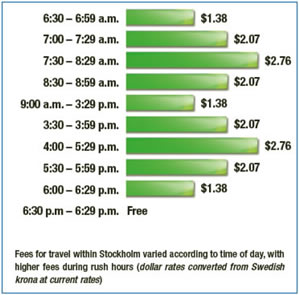
Stockholm takes second place because it stepped prices in four stages for each of the morning and afternoon rush hours setting it low in between the two peak times and zero after the workday was complete. You can see that in the figure:

London and Norway tie for third place.

London qualifies because it has more than one level of price. Peak hour (all day) and not peak (all night). Because it is a flat all or none rate that never raises or lowers it does not distinguish between 8:00 AM and 2:00 PM, so it is a pretty crude price signal. But is certainly put a dent in congestion.

Two of the three Norwegian cities involved toll at a flat rate blunting their signal value, but the third (Tronheim) tolled variably, but had now been discontinued due to a political promise, showing that its initial intention was to raise revenue even though it operated as a TDM method while it lasted.

You can see how the need to finance infrastructure and the need to manage demand get completely intertwined. The reason this matters is that to many people it all just looks like taxes and its visibility gets diluted when road-user charging gets joined by fuel taxes and property taxes and other revenue sources needed to barely keep it working.

The sooner we switch from fuel-tax, plus property tax, plus any available tax, plus annoying tolls to pay-per-use everywhere, the sooner we’ll have clear pricing signals. The sooner we have clear pricing signals, (plus transit, plus bike paths, plus other things) the sooner we’ll have reliable networks.

But proper market pricing is the foundation.

2007/04/30

Unlocking Gridlock in New York

Last week’s press in New York is judging Mayor Bloomberg’s Congestion Pricing proposal (part of PlaNYC) far less harshly that the British press has criticized Mayor Livingstone’s efforts in London. Is this a sign of greater trust of government in the U.S. as compared to the UK, a reflection of the greater social maturity of New Yorkers, or is it due only to the sobering and compounding fears of Global Warming? While I dare hope it is some of the second, I suspect it is mostly the latter.

I usually see little popular press that does not misconstrue one aspect or another of the value or intention of congestion pricing – even when it comes down in favor. Last week was an exception.

From the City Desk of NYT: Unlocking Gridlock understands that congestion pricing is not synonymous with a tax-grab on the working poor.

Opponents of the plan, particularly those in car-dependent Queens, are flat wrong in calling the fee a tax on the working class. With the additional investment in rapid bus routes, ferries and transit links, workers would benefit from more choices.

Full marks.

Another article has the mayor explaining the emissions-asthma connection to a church group. Nice to bring home the message that our cars today are harming our own kids’ health.

Imposing congestion fees, the mayor said, “will encourage people to take mass transit, it will give us the money to build more mass transit, it will clean the air and give our children much better air to breathe — and also for adults, incidentally.”

He didn’t even need to bring up the terrible toll in wasted time and fuel that congestion brings. He did point out, however, that he actually has a moral obligation:

“In my faith … there is a religious obligation … to make the world whole, or to correct error[s] and end injustice. And that responsibility is found among people of good will in every faith.”

Nice touch.

An even bigger surprise is that at least one blog, the Gothamist, attracted a majority of pro-comments. The balance, here, far outstripped anything I have seen in the UK. It may be premature, but New Yorkers in 2007 do not at all look like the grousing Londoners of 2002 (or 2007, for that matter).

Here is an example of New York thoughtful street debate rather than the fist-shaking drivel common to the UK online news commenters:

“I am on the fence on this one, but the "inconvenient truth" about this scheme is that commuters from outside Manhattan will more than likely drive into the boroughs and park there increasing traffic and pollution in the streets of those areas, effectively exporting it from Manhattan. The reason I say this is suburban commuters who have to own a car to survive will not [want to] pay hundreds of bucks a month for a monthly train ticket in addition to their car payments, insurance, etc. They will drive into Brooklyn, Queens or the Bronx and then take a subway from there, making transit more crowded for those residents as well, while Manhattan becomes a playground for wealthy folks to zoom around in unencumbered. – [Sammy | April 23, 2007]

Sammy: I realize [I’m] one of the few, but I actually own a car, [make] monthly payments … plus insurance... however, I also pay $250 a month for a monthly train pass, and $76 for the metrocard to get to work every morning. I absolutely abhor driving in traffic every morning to get to work...although its easier to drive, my sanity has been kept in check because I do not have to sit in traffic for hours on end. Also, with gas prices the way they are, plus tolls, the cost of my commute is roughly equal to what I pay for mass transit. – [K. | April 23, 2007]

Not only does K point out that you can’t beat the congestion equation with a car, but Sammy also points out a very important problem: Congestion pricing now only keeps some cars at home, it also shifts some around. Planners need to anticipate and address additional parking requirements at the middle and outer reaches of the transit system in addition to additional transit capacity. People like Sammy need to know this is going to happen.

Intelligent debate beats ranting anytime.

Renews my faith in America, this does.

2007/04/22

A Brilliant Insight

I have started a new writing assignment for one of my UK publishers who asked me to prepare 2000 words on “Congestion Pricing in Ontario” just in time for an Intelligent Transport Systems conference. (Yes, Virginia, since Congestion Pricing is part of the arcane field of endeavor called “Intelligent Transportation Systems”, that absolutely does imply that unpriced-roads should be called “Unintelligent Transportation Systems”, which is pretty much what this blog has been saying since its inception.)

In any case, I have a colleague, Justin Peters, who has a far deeper grasp of government (any government) than I do. So, I sent him an email:

The new taxing powers recently granted to Toronto appear (in the press) to allow our mayor to toll roads without further permission. Do I understand that correctly? What else needs to be done (besides the political will and the technical system) to deploy congestion tolling in or around the GTA. (i.e., can the Province promote or stop this? The Feds? If you had to guess, by when do you think some form of congestion pricing would be put in place anywhere in Ontario?

My quandary is that I do not understand how this will roll out in Canada. In the US, the feds are putting up money for the states/cities to trial some ideas – it remains to be seen how that will play out, but there are already some cities looking hard and (for example) Vegas is about to rescind its "no-toll" law. There is no sign of that kind of shift here, but there is certainly a congestion problem in Toronto and in Vancouver. Indeed Toronto's Mayor Miller now says "tolling must be regional not 'just Toronto' " whereas before he said "no tolling", period. What does your crystal ball say re Toronto? How will this realistically play out?

His reply:

You are correct with respect to the City's ability to toll with new powers in the City Of Toronto Act. The only place where that power might be limited would be on the 400-series roads which may require Provincial Authority.

Municipalities are 'a creature of the Province' so the Feds would be way out of line and with the Federal Conservatives, off Party-line, to interfere. Conversely, if the Feds wanted to phase out Fed Gas Tax or GST on Gas, then they might sponsor Pay-Per-Use. Also, ECOMobility funds from the federal government are being made available for these types of Transport Demand Management measures. (Similar to USDoT's Urban Partnerships Agreements - constitutionality stretching National Goals.)

However, given the Mayor's position that tolling ought to be a GTA-wide strategy, the GTTA and Provincial governments will be needed to make things happen. But if Mayor Miller endorsed Road User Charging in the GTA and started a campaign to achieve it instead of his silly GST-penny thing, both other players would be forced to act. This would send a dual signal that the City of Toronto is serious about its budgetary problems and about climate change.
[bolding mine]

2007/04/08

Where to find Giambrone’s $6B

Toronto Councillor Adam Giambrone intends to rescue Toronto Transit from its long downward slide.

I recently predicted Giambrone would be mayor of Toronto in 12 years. Kelly Patrick’s long homage to him in Saturday’s Post (07.04.07) supports my case. This guy cares (10 points), is smart (20 points), has passion (20 points) and has balls (50 points). Hopefully he is a closet libertarian, too.

Giambrone is looking for $6B over 15 years to fix Toronto’s Transit and there is a very sensible way for him to get every cent of that in a socially fair (Left), fiscally responsible (Right) and environmentally responsible (Green) manner. And he can intelligently address congestion at the same time (Libertarian).

Wait. Did I just hear you think “it’s obvious congestion would be fixed by $6B in new transit”? It’s not obvious. You can’t fix congestion by building transit systems, any more than by building roads. You fix congestion by putting commuters onto transit. If you think those are two ways to say the same thing, then you’re dreaming bigger than me. Recall the old Irish proverb: “…a fool and his car are not easily parted.”

The $6B Giambrone plan is long overdue. Why we boomers had to wait for a 29 year old that looks 19 to explain this, I’ll never fathom. We really should be ashamed of ourselves, since Jane Jacobs, who predates boomers by 40 years, explained all this in 1961 in Chapter 18 of her Urbanist handbook The Death and Life of Great American Cities. In 1961 the oldest boomer on the planet was a pubescent 16. There is no excuse for the Waiting for Giambrone drama that has been playing on Toronto’s municipal transport stage for the past 35 years.

And Giambrone’s plan only addresses pent-up demand – not the hot, gaseous future. Over the 15 years his plan would take to unfold Toronto’s automobile population will increase by 56% (using the standard 3% per year rule-of-thumb). At the same time the number of new or widened roads will increase by a whopping 0%. In fact, the carrying capacity of existing roads will decrease during that time since roads carry fewer cars per lane-hour as they get more congested, even fewer as they will be under repair if Toronto’s mayors ever can find the hundreds of millions needed for infrastructure repair.

[Pop Quiz:

#1: If it now takes you 75 minutes for your round-trip commute each day, and we add 56% more cars to our roads, how long will it take you to make the same commute in 2022? Answer: on the order of 3 or 4 times longer. Once roads are filled past their capacity, the effect of congestion rises much faster than does the growth in the automobile population.

#2: It can be easily proven that the endgame for congestion is a 24 hour commute per day. So when are we going to start addressing it seriously?

#3: Which is farther away: 2022 or 1992? And you thought 2022 is too far away, to worry about, eh?]

By now some of you may be thinking: “Giambrone’s plan will absorb that extra 56%”. And I hope it does absorb that much. But if it did that, we would only land in 2022 in the same congested place we are in 2007 except with far larger potholes and less asphalt between them. Worse we’ll have only tiny cars to navigate those potholes because the SUVs needed for the perilous trek from Oakville to Bay Street will be taxed out of existence by then.

Ok, it is true that good transit (i.e., frequent, reasonably safe, comfortable, modestly priced and with a minimal number of transfers) attracts ridership. But the attraction of autonomous travel will always trump transit as long as transit-use and road-use are as mis-priced as they currently are.

Without a proper market pricing mechanism you cannot fairly apportion a scarce good – that would be road space in this column. You can ban cars on King Street (with due respect to Mr. Giambrone, this is a tiny, limited, annoying and unfair idea that I will discuss shortly in Tax, Ban, Tolerate or Price). You can impose a tax on SUVs and provide a rebate on tiny cars (whoa, that one was REALLY dumb: rebate a car purchase? Why not toss in free gas, too?), But, please, there is nothing wrong with owning a car, and there is nothing wrong with driving a car. The problem is when we all drive on King Street at the same time and during the day when 35% of us are circling around looking for a cheap on-street parking spot since on-street parking is waaay-cheap and off-street parking is not so.

Now you can’t effectively toll just King Street. In fact, congestion pricing has to be a wide area thing, not just a small cordon or the DVP-QEW idea, so the problem is how to get from the mis-priced mess we have to a properly priced transport system – and a system where road and transit collaborates instead of competes.

In a few weeks, I will work through a staged plan, available on this blog, to accomplish a market system interconnecting parking, road funding and transit funding. This will be self sustaining, fair and will not require begging for money from the other levels of government (although clearly Toronto has taken it on the chops on this account). The net result will be to produce the $400M Giambrone needs annually and open our roads at the same time. Here is an outline:

Phase 1: Allow parking payment via no-touch, GPS-based parking meters (these completely revolutionize parking management). Start reducing free-parking via legislating parking cash-outs and taxing the non-compliant.
Result: Noticeable increase in transit ridership. You may have to add a few buses. Revenue neutral. Greater convenience for motorists who continue driving.

Phase 2: Reduce parking management costs, increase parking revenue, and improve parking turnover with per-minute parking and accelerated payment structures in lieu of ticketing – i.e. after a fair parking period at a few cents per minute, the rate increases considerably, but no expensive, customer-abusing citations. Handle payments with the hands-free GPS meters in Phase 1.
Result: 50% increase in net parking revenue. Further increase in transit ridership. Add more buses.

Phase 3: Reward motorists who do not move their vehicles during peak hours with parking credits. Further reduce free parking by uniformly and aggressively enforcing ONE-HOUR and THREE-HOUR free parking. Start metering non-resident parking in residential areas. Handle compliant payments with the Phase 1 meters (meter users are citation-proof unlike now). Adjust on-street parking rates to meet Donald Shoup’s 85% occupancy target (The High Price of Free Parking).
Result: an additional 100% increase in parking revenues. Further increase in transit ridership. Add more buses. Shorten subway headways.

Phase 4: Tax monthly parking passes out of existence; allow parking loyalty passes (park nine days and get one free) in lieu of monthly parking (such passes discourage occasional transit use). Handled by the hands-free Phase 1 meters.
Result: Revenue neutral, another increase in transit ridership.

Phase 5: Add a “landing fee” for parking or a departure fee for “unparking” in a congestion zone during peak times. Handled trivially by the Phase 1 hands-free meters.
Result: Increase in revenue neutral, major increase in transit ridership.

[By now there will be a 30% drop in peak-hour traffic, AND we’ll have most of Giambrone’s money.]

Phase 6: Institute a mileage credit exchange to make this fairer to non-motorists.
Result: Motorists directly subsidize transit riders. Non-motorists (read “disadvantaged” or “willing-to-switch-to-transit” as you wish) benefit directly instead of indirectly. The “unfairness-of-road-pricing-to-the-disadvantaged” is further mitigated. Revenue neutral, government kudos.

Phase 7: Institute staged congestion pricing. Handled trivially by the hands-free meters in Phase 1. Don’t even consider pricing the DVP or QEW more than surrounding roads.
Result: All of Giambrone’s money and much more (to fix the roads, of course).

To complete this in detail, I need help from someone who knows Toronto traffic numbers as an advisor and fact-checker. Any volunteers? Should only take a couple of hours. Confidentiality respected. berngrush [at]ieee[dot]org.

2007/03/30

Home and Mobility Taxes

Let’s review a recent Toronto Star article Drinks, movies among tax targets (John Spears, 07.03.27), which contains several skewed sound-bites and implications about road pricing. So from the top…

The article is about taxes. Raising a sorely needed $340M for our impoverished city. The alcohol part is 18% and the movie part is 1%. But the land-transfer, road tolls, vehicle registration surcharge, and parking surcharge portions are 30%, 13%, 12% and 2% respectively – i.e. 19% for drinking while watching a movie and 57% for driving to work so you can pay your mortgage.

This sounds like a formula for … what? This is even dumber than communism.

So first, John, let’s change your title to “Your home and mobility among tax targets”.

Since you know I am advocate of congestion pricing, you might think I’d be delighted.

I’m not. The stated intentions for are clearly for raising revenue (that part is good), but they are ONLY for raising money. That part is absolutely irresponsible when the power of taxation is as misapplied to road tolls, vehicle registration, and parking as this article and several others on this budget suggests.

Moving on: “[m]any of the proposed levies are "sin taxes"… Well alcohol and tobacco is 27% of this, entertainment and billboards, is 6% and the rest, 57%, is your home and car – hardly sinful possessions.

So let’s rewrite that as “A minority of the proposed levies are ‘sin taxes’; the rest are a straight misapplication of progressive taxation theory.

Councillor Shelley Carroll apparently said [these tax proposals] “signal that the city has reached the limit of what it can finance through property taxes.” Full marks to Councillor Carroll.

Councillor Doug Holyday apparently said “the city shouldn't be looking at any new taxes: ‘You want to drive our businesses out of the city, this is the way to do it…’" I don’t see how the city can avoid its responsibility to find new revenue, so that portion of his remark is at best misleading. However, he is right that doing it the way described will drive people away. So if Miller wants to “invest in city building” lets avoid regressive taxation measures. Half marks to Councillor Holyday.

Councillor Gloria Lindsay Luby is right to suggest that “introducing tolls on the Gardiner [amounts] to erecting a gate at the city's border”, but she did not point out that that’s because it is the wrong approach to road tolling. That is how you toll for road building – not for congestion.

Luby was unhelpful to say, “To hell with the economic impacts of these things, we're just going to close ourselves off. I don't think that's the way we should go." I would rather the Councillor just repeat Mayor Miller’s brilliant insight: “Tolling has to be regional” – a comment that earns Miller an A+ in the grushhour playbook.

Fortunately, Luby redeems herself somewhat when she says "I don't know that it is worth trying to get the (public consultation) going in the community unless they understand what the economic implications are." She is soooo right, but I also doubt most of our politicians really understand the full implications of a properly designed and coordinated congestion pricing scheme – one that is regional, graduated, congestion sensitive, and, in sufficient scope, with fuel tax rebates – that supports both road building and transit. C+ for Councillor Luby.

Faye Lyons (CAA) noted that “too many of the proposed taxes hit drivers.” I’d give her higher marks if she had said “all of these automotive levies are regressive, hence would have no effect on congestion”. I am sure that her constituency would prefer any additional tax burden to reduce congestion as a return on their new “automotive investment.”

Ms Lyons said "Motorists are an easy target for this council," which is correct, but she is way off the mark to say “motorists are already overburdened and overtaxed”. Property owners subsidize roads. Motorists’ are in fact supported by every pedestrian, bicyclist and transit user that owns or rents taxed property in this city. If you are not a motorist and not homeless you are the one who is “already overburdened and overtaxed”.

Ms Lyons also said: “tolls on the Gardiner or DVP would only force more cars onto residential roads, causing traffic jams, air pollution and accidents.” She is right, but she does not offer the fuller Millerian insight: “Tolling has to be regional”. Faye Lyons gets a D.

I just wish Mayor Miller would finish that little sentence of his: “Tolling has to be regional, and I am going to push hard for that at every ‘smart-everything’ and green-everything’ meeting I attend”.

Without that degree of courage and conviction, Mayor Miller looses marks. C-. Actually D-, since he’s our leader.

2007/03/26

3 out of 3: Americans prefer tolling

A mini-poll of transportation experts undertaken by Traffic Technology International (TTI) was published in February 2007. The question posed was: “Many technologies have had a positive effect on our roads networks, but which … has been the most influential so far? Of the six replies re-printed two said “wireless communication” and three said “electronic toll collection (ETC)”, including Germany’s GPS-based system. Although TTI is a UK publication, 3 of the 3 respondents pointing to ETC as the winner were from the USA. The other replies were from the UK or Canada.

Since this is not online, here are some outtakes:

“ETC using automatic vehicle identification [e.g. EZPass or the 407] has a daily impact on millions of commuters and results in time savings for drivers, operational savings for road authorities, and reductions in vehicle emissions, which benefit the environment.” (Charlie Mitchell, TMRI)

“…it may help usher in universal mileage (distance-based) fees in the USA to replace the fuel-tax as the chief source of user-based road revenue. With the concurrent advancement of GPS and GIS it will be feasible to charge for travel not only on ordinary highways and low-volume rural roads, and even city streets.” (Kenneth Orski, Innovation Briefs)

“ETC …[addresses] transportation funding shortfalls, finances new capacity, and manages congestion …the use of tolling to enhance mobility through congestion pricing, variable pricing and other forms of demand management, bears out its enduring impact. Electronic tolling has also influenced a great deal of progressive thinking on how we can promote efficiency in the use of infrastructure, stimulate private financing and investment and provide cost-effective solutions to mobility challenges.” (Mark Dooley, BAH)

All this indicates a few good things. Tolling fixes two critical problems: funding and congestion. And Americans now get it every bit as much as the Europeans. To those of you who despair that we can't figure our way out of this, the solution is coming.